

In a feat that pushes the boundaries of robotic speed and endurance, Zhejiang University’s quadruped robot, White Rhino, has claimed a new Guinness World Record for the fastest 100 meters by a four-legged machine. Achieving the run in 16.33 seconds, it outpaced the previous record of 19.87 seconds set by South Korea’s “Hound.”
The record-setting sprint took place in Hangzhou, capital of Zhejiang Province. For comparison, the human world record held by Usain Bolt since 2009 stands at 9.58 seconds, but White Rhino’s time signals remarkable advancements in machine locomotion.
White Rhino’s development brought together the university’s Center for X-Mechanics, School of Aeronautics and Astronautics, and the Hangzhou Global Scientific and Technological Innovation Center. The team’s approach, described as robot forward design, meant building from the ground up rather than modifying an existing frame. Using comprehensive dynamics simulations, they optimized every joint, actuator, and motor specification simultaneously.
High-power-density joint actuators, likened by the developers to a “racing-grade muscular system”, allowed the robot to generate explosive torque with rapid response. Meanwhile, its motion control relied on reinforcement learning to orchestrate bursts of speed, swift leg swings, and real-time balance adjustments.
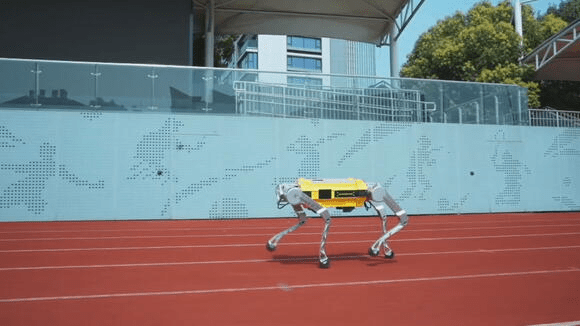
“This was a very demanding goal,” explained Professor Wang Hongtao, the project leader. “The 100-meter sprint tests the robot’s explosive power and speed, but also examines the robot’s stability and precise control in conducting rapid movements. More importantly, it allows us to determine if we are on the right research path.”
Beyond speed, White Rhino boasts an impressive maximum load capacity of 100 kilograms (220 pounds). This dual capability—high-speed running and heavy-load performance—makes it unique among research robots.
“Most notably, its maximum load is 100 kilograms, making it a quadruped robot capable of both high-speed running and heavy-load performance,” said Dr. Cheng Shaowen. He emphasized that the team’s vision extends beyond raw performance, aiming to move from “running fast” to “running usefully.”
Such versatility could prove invaluable in search-and-rescue missions, disaster relief, and carrying supplies or sensors over terrain inaccessible to wheeled vehicles. The next steps in development will focus on improving robustness, energy efficiency, and perception systems to enable autonomous navigation in dynamic real-world environments.


