

China has once again showcased its growing maritime might, unveiling a new generation of intelligent and disruptive underwater unmanned systems. Featured during the September 3 military parade in Beijing commemorating the 80th anniversary of victory over Japan, these cutting-edge submersibles show the nation’s accelerating efforts to dominate undersea warfare through advanced technology and AI.
According to a recent article in a Chinese military journal, the new submersibles are capable of zero-radius turning manoeuvrability, enabling seamless operation in challenging and confined underwater environments. The systems reportedly operate below 90 decibels, minimizing the risk of detection by sonar, and can be integrated with submarine-launched missiles, smart mines, or “mother-daughter” unmanned vehicles forming what the report described as a “multilayered strike network.”
The Beijing parade also underscored China’s steadily expanding arsenal from intercontinental ballistic missiles and stealth drones to carrier-based aircraft signaling an intensified focus on multi-domain warfare readiness.
An article published in Ordnance Industry Science Technology further detailed the People’s Liberation Army Navy’s (PLAN) deployment of unmanned submersibles, surface vessels, and autonomous minelaying systems designed for coordinated blockades and saturation attacks. These unmanned assets can autonomously identify targets, conduct covert operations to disrupt shipping lanes, and are expected to possess extended endurance, possibly enhanced by future underwater charging station technology.
While Russian sources have reported similar naval developments, Beijing has remained discreet about its own undersea infrastructure. Nevertheless, reports cited by the South China Morning Post emphasized the “advanced intelligence” capabilities of these systems, which could achieve three-dimensional coordination with surface and aerial drones through AI.
The journal highlighted that these autonomous vessels are capable of independent decision-making, allowing them to assess threats and identify targets.
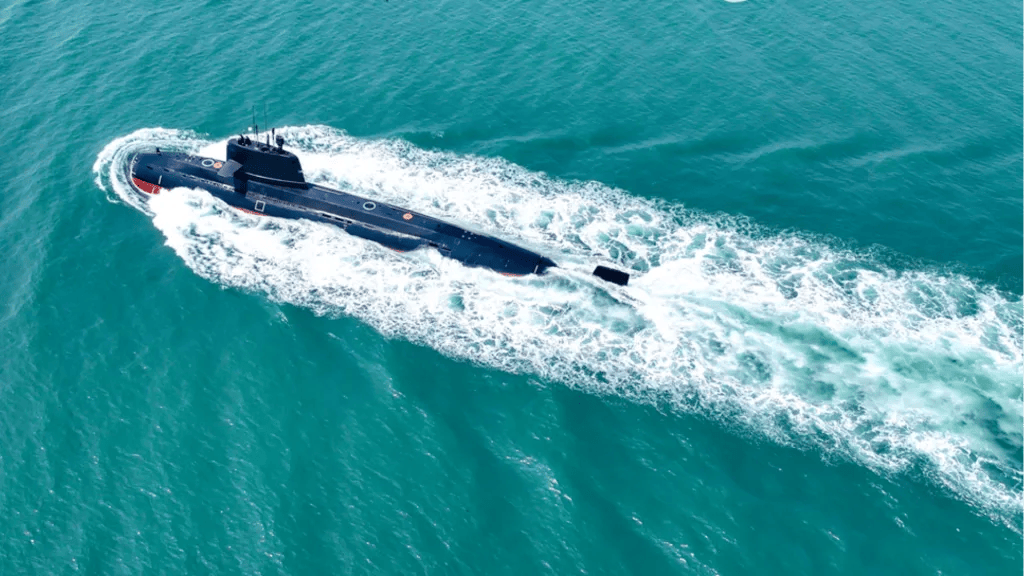
Military analysts suggest that drone swarms of such unmanned vessels could “redefine maritime confrontation,” turning them into a decisive element in future battles for sea control. This capability not only strengthens China’s capacity to enforce sovereignty claims, particularly in disputed waters, but also adds layers of complexity to global maritime governance and security.
Central to this effort is the AJX002 unmanned minelaying system, a 59–65-foot-long underwater drone described as a deep-sea defensive stronghold capable of cutting off enemy supply lines through asymmetric tactics. Powered by a pump-jet propulsion system, the AJX002 bears resemblance to Russia’s Poseidon nuclear torpedo, though its nuclear capability remains unconfirmed.
China’s ambitions to establish a formidable blue-water navy by 2035 remain at the core of its maritime modernization strategy. Projections indicate the PLAN could operate up to six aircraft carriers by then — a move seen as pivotal for any potential Taiwan Strait conflict, particularly in amphibious operations and countering U.S. intervention.
Experts observe that the advanced weaponry displayed at the recent parade reflects Beijing’s intensified focus on defending its territorial claims, deterring secessionist actions, and asserting dominance in regional maritime security. Collectively, these developments reveal a clear trajectory: China is building not just a larger navy but a smarter, autonomous, and globally assertive maritime force.


