

China has made headlines once again in the race for sustainable energy, thanks to a breakthrough in nuclear fusion research that could reshape the world’s energy future. The country’s Experimental Advanced Superconducting Tokamak (EAST), also known as the “artificial sun,” recently sustained plasma for an unprecedented 1,066 seconds.
Fusion, the process that powers stars occurs when light atomic nuclei merge to form heavier ones, unleashing vast amounts of energy in the process. Unlike nuclear fission, the method used in today’s reactors, fusion produces minimal radioactive waste and carries much lower risk. EAST, located in Hefei, is designed to recreate these stellar reactions on Earth by confining plasma heated to more than 180 million degrees Fahrenheit inside a doughnut-shaped chamber, held in place by powerful magnetic fields.
Scientists across the globe have long pursued fusion as the ultimate energy solution, and the latest results from EAST demonstrate meaningful progress. Sustaining plasma for over 17 minutes shows that magnetic confinement is becoming increasingly effective at stabilizing the extreme conditions required for fusion. This marks a critical benchmark, not only for China’s research program but also for international efforts to make fusion power a reality.
On January 20, 2025, EAST entered the record books by maintaining a steady-state high-confinement plasma operation for 1,066 seconds. What makes this remarkable is not simply the length of time but the stability achieved at such extreme temperatures. Scientists view this as proof that key hurdles such as controlling plasma turbulence and maintaining efficiency are being overcome. Each advancement like this brings researchers one step closer to achieving the ultimate goal: a self-sustaining fusion reaction that produces more energy than it consumes.
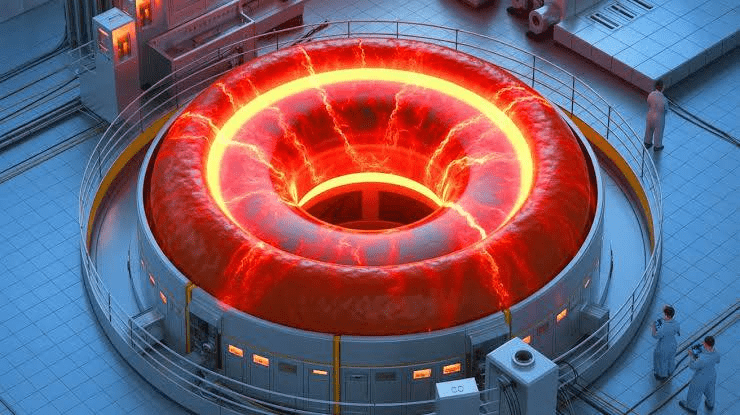
The potential of fusion as a clean energy source is immense. Unlike fossil fuels, fusion emits no greenhouse gases, and unlike traditional nuclear power, it leaves behind little hazardous waste. If harnessed effectively, it could provide humanity with an almost inexhaustible energy supply. EAST’s achievement is therefore more than a scientific milestone, it’s a signal that the dream of carbon-free, large-scale energy generation is edging closer to reality.
Still, the path ahead is daunting. Creating materials that can withstand the punishing heat and radiation inside reactors remains one of the biggest obstacles. Another challenge is achieving net positive energy output where a fusion reactor generates more energy than it consumes to sustain the plasma. These technical barriers mean that, despite progress, fusion is still years away from practical deployment.
China’s success places it firmly in the spotlight of the global fusion race, but it also feeds into broader international collaboration. Lessons from EAST are expected to benefit projects like the International Thermonuclear Experimental Reactor (ITER) in France, where multiple nations are pooling expertise and resources.


, also known as the “artificial sun,” recently sustained plasma for an unprecedented 1,066 seconds. Fusion, the process that powers stars occurs […]&media=https://wonderfulengineering.com/wp-content/uploads/2025/08/image-236.png)