

While the United States continues to grapple with outdated infrastructure and stalled rail projects, China is forging full steam ahead, or rather, full levitation ahead. The country’s latest breakthrough in high-speed transportation comes in the form of a futuristic train that doesn’t just run on tracks but hovers above them. Welcome to the world of magnetic levitation, where speeds once thought impossible on land are becoming reality.
Magnetic levitation or “maglev” technology relies on powerful magnets to lift and propel trains, eliminating the friction caused by wheels and rails. This results in not just a smoother ride but one that can clock in jaw-dropping speeds. Although nations like Japan and South Korea already operate some lower-speed maglev systems, China’s engineers are setting their sights and speeds far higher.
In recent developments, Chinese developers claim to have tested a maglev prototype reaching a staggering 650 kilometers per hour (around 400 mph). To put that in perspective, such velocity could slash coast-to-coast U.S. travel times dramatically; a hypothetical New York to Los Angeles trip could be completed in under seven hours.
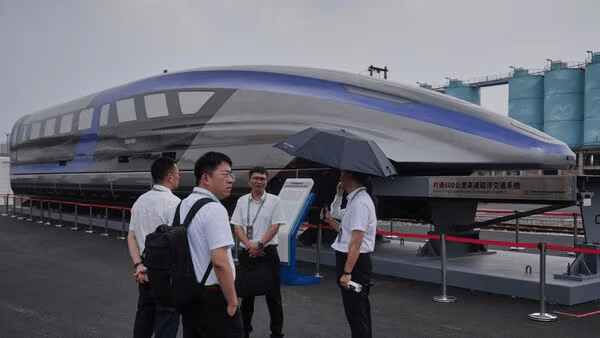
The roots of this high-speed marvel trace back to 2019, when Chinese state media announced the construction of a research and development lab and a production center in Qingdao. Fast forward to June, and the 650 kmph milestone was officially unveiled at the 12th World Congress on High-Speed Rail in Beijing, where developers demonstrated the system’s cutting-edge capabilities.
The train initially rolls out on traditional rubber wheels until it hits 100–200 kmph. At that point, the train begins to levitate, hovering less than half an inch above the track as the wheels retract. Then, the real magic begins.
“It’s a matter of how fast you want to go,” said Li Weichao, director of the testing lab, during an interview with CGTV. Li emphasized that while the train reached 650 kmph in tests, the team is aiming even higher. “Its typical operating speed is 800 kmph,” he claimed — a blistering 500 mph, making it the fastest land-speed train prototype in existence.
Li added that “the entire construction is expected to be completed by the end of this year, and the platform will meet the conditions for acceptance.” He confidently declared, “This is the fastest speed in the world.”
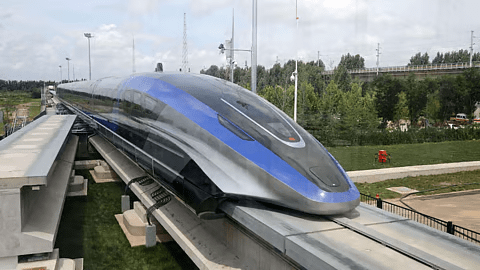
Yet, bridging the gap between laboratory feats and public rail lines isn’t easy. Even Japan, a global pioneer in bullet train technology, has delayed its ambitious $64 billion maglev project due to disputes over tunneling through the Japanese Alps. Similarly, a proposed maglev linking Washington, DC, to Baltimore, a trip that could take just 15 minutes, is stuck in bureaucratic limbo due to environmental concerns.
In contrast, China already operates the Shanghai-Hangzhou Maglev, which holds the current record as the fastest operational train on the planet at 431 kmph (267 mph). If any country has the resources, vision, and momentum to break into the 800 kmph club, it’s China.


