

Two enormous impulse turbines with a combined 500 MW rating were recently unveiled by China. These high-efficiency hydropower-generating turbines are scheduled to be installed at Tibet’s Datang Zala Hydropower Station on the Yuqu River. Made of high-strength martensitic steel, each turbine weighs 80 tonnes and has an impressive outer diameter of 20 feet, 5 inches (6.2 meters). Together with design improvements, these turbines’ 21 water ladles will increase efficiency from 91% to 92.6%, generating an additional 190,000 kWh of electricity daily.
With a 1,000 MW installed capacity, the Datang Zala project is intended to use gravity alone to supply water at a sufficient speed and pressure to power the turbines with remarkable efficiency. The hydropower station meets the requirements for a “high head” system, in which the water source is situated much higher than the turbine, with a vertical drop of 2,201 feet (671 meters) from the reservoir. With this special configuration, CO2 emissions are reduced by 3.4 million tonnes annually while nearly 4 billion kWh of energy are produced annually, which is the same as burning 1.3 million tonnes of coal.
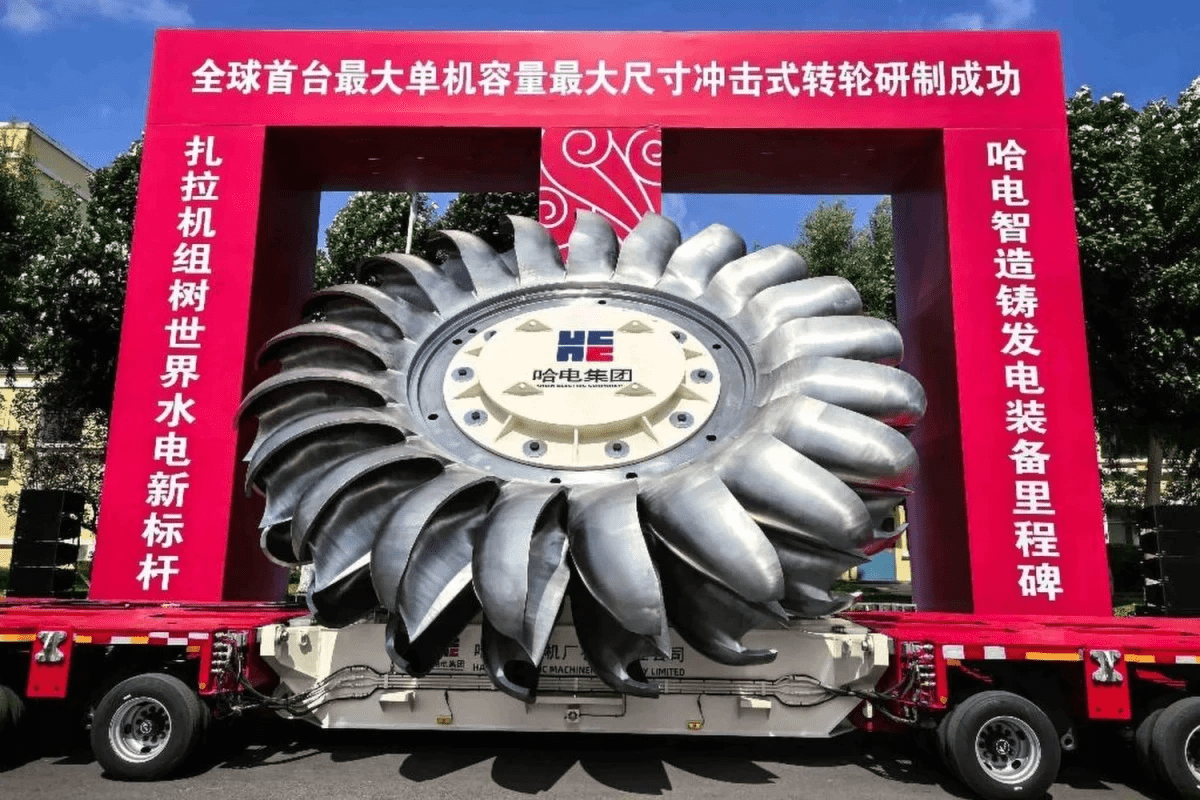
The turbines have a Pelton wheel impulse design and were built over four years by Harbin Electric using in-house technology. These kinds of impulse turbines turn the turbine’s buckets to produce electricity by aiming high-pressure water jets at them. Impulse turbines work in the air, which makes them perfect for high-head systems, in contrast to conventional reaction turbines, which are immersed in water. In order to endure the continuous force applied to them, the turbines’ selection of martensitic steel guarantees increased strength and resistance to corrosion.
Although the project is still a few years away from completion—it is anticipated to be online by 2028—it demonstrates China’s dedication to clean energy, as the nation strives to become carbon neutral by 2060. China maintains its position as the world’s largest hydropower producer with the Datang Zala Hydropower Station, which increases its capacity to 436 GW. But the growth of such massive projects, like the neighbouring Yarlung Tsangpo, brings up difficult global problems, particularly with regard to regional relations and water management.


