

China’s state-run media has revealed the country’s latest domestically developed drone technology, a vertical take-off and landing (VTOL) tail-sitter UAV showcased during a recent disaster response drill held in the mountainous terrain of Sichuan Province.
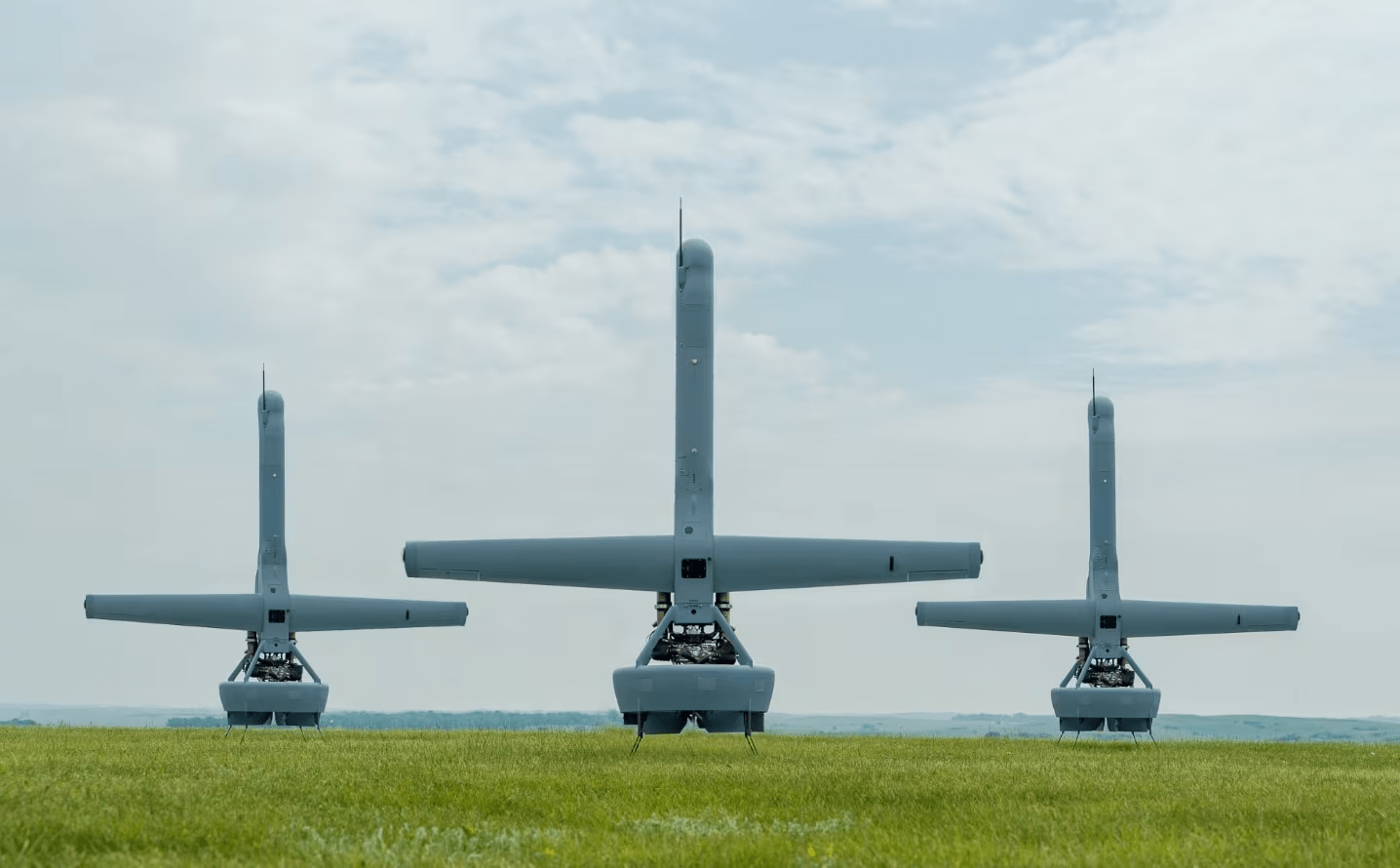
The newly unveiled drone stands 1.8 meters tall and features a 2.6-meter wingspan. It is powered by a single ducted-fan engine, a design choice that balances vertical lift with efficient forward motion, providing a significant edge over conventional quadcopters. Fitted with a gimbal-mounted system, the drone carries both infrared and visible light cameras, making it well-suited for complex search-and-rescue or reconnaissance missions, especially in rugged environments like plateaus or mountainous zones.
Engineered with modularity in mind, the drone’s payload can be tailored to specific mission demands. Operators can swap in different components, such as cameras, environmental sensors, or even smoke and illumination systems for signaling. This versatility makes the aircraft ideal for fast deployment in disaster relief operations or field reconnaissance, particularly in areas where infrastructure is damaged or inaccessible.
The drone operates on CAIG’s Wenyao control system, an AI-enhanced platform that enables automated flight planning, intelligent obstacle avoidance, and even coordinated swarm operations. With AI at the core of the control interface, the system reduces the burden on human operators and allows for more agile, responsive deployment in high-pressure scenarios.
Perhaps the most notable aspect of the drone’s design is its resemblance to the U.S.-developed V-BAT drone produced by Shield AI. Both aircraft share a ducted-fan tail-sitter architecture, allowing them to launch vertically like helicopters and then transition into efficient horizontal flight like airplanes. This hybrid approach is increasingly attractive for missions that demand both compact deployment and long-range coverage. However, while similar in function and appearance, analysts point out that China’s model differs in scale and appears to be an independent adaptation rather than a direct copy.


 tail-sitter UAV showcased during a recent disaster response drill held in the mountainous terrain of Sichuan Province. The newly unveiled drone stands 1.8 meters tall and features a 2.6-meter wingspan. It is powered by a single ducted-fan […]&media=https://wonderfulengineering.com/wp-content/uploads/2025/07/image-255.png)