

Researchers in China have made a world record by propelling a 1.1-ton test vehicle to 650 km/h in 7 seconds, a breakthrough in magnetic levitation (maglev) technology. The record-breaking speed was set at the Donghu Laboratory in Hubei Province, where a small 1,000-meter maglev test track was constructed with state-of-the-art electromagnetic propulsion and levitation technologies.
Li Weichao, director of the High-Speed Maglev Electromagnetic Propulsion Technology Innovation Center, said that the test vehicle achieved its maximum speed in just 600 meters of travel. Li said the breakthrough was the fastest in the world, telling China Media Group that the speed was an important milestone.
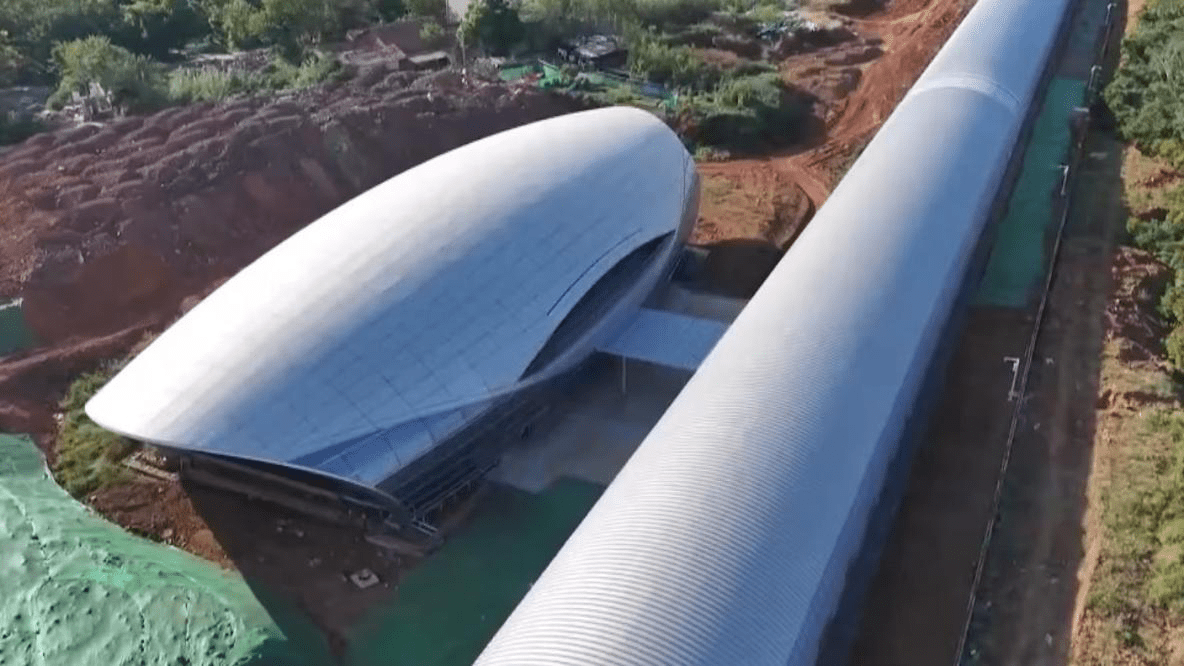
This short-distance maglev system uses ultra-precise positioning and speed tracking, unlike the traditional high-speed test tracks that need 30 to 40 kilometers of runway. Li said that the accuracy of the measurement is within 4 millimeters, which enables precise control of the levitating vehicle.
The vehicle floats above the track using electromagnetic forces—specifically, “like-pole repulsion”—eliminating friction. Consequently, the car just has to beat the air resistance when accelerating, and such high speeds are possible on shorter circuits.
What is more amazing is that the system enables the vehicle to reduce its speed of 650 km/h to a full stop in only 200 meters. The target of the laboratory does not end at 650 km/h; the test line is planned to reach up to 800 km/h. The entire construction is projected to be finished by the end of 2025, and then it will be officially tested to be used more widely.
In addition to record-breaking, Li also stressed that the test platform might find extensive use in civilian transportation. The advanced technology is already being incorporated into other research projects, which is a revolutionary move towards the future high-speed rail systems.


 technology. The record-breaking speed was set at the Donghu Laboratory in Hubei Province, where a small 1,000-meter maglev test track was constructed with state-of-the-art electromagnetic propulsion and levitation technologies. […]&media=https://wonderfulengineering.com/wp-content/uploads/2025/06/06aaa687-ee3e-474f-bc0b-2ff3ef5af3c3.jpeg)