

The jet blasting out of the black hole at the centre of the galaxy M87. Jan Röder; Maciek Wielgus et al.
Astronomers have taken a closer look at one of the most iconic cosmic phenomena — the colossal jet streaming from the supermassive black hole at the heart of galaxy M87. First spotted more than a century ago, the jet has been studied by countless telescopes, but the James Webb Space Telescope (JWST) has now unveiled unprecedented details.
The jet from M87’s black hole also the first black hole ever directly imaged in 2019 was first observed in 1918 by astronomer Heber Curtis. For decades, researchers have puzzled over its strange features, from its bright glowing knots to darker, spiral-like regions. These patterns may be linked to the jet compressing and refocusing as it pushes through surrounding gas, but the full mechanisms remain a mystery.
A team led by Maciek Wielgus at the Institute of Astrophysics of Andalusia used JWST’s powerful infrared sensors to re-examine archived data originally collected to study M87’s stars. The glare from those stars nearly drowned out the jet, but careful reanalysis revealed its structure in exceptional detail. “It’s a very practical example of what astronomers often say, which is one astronomer’s trash is another astronomer’s data,” Wielgus explained.
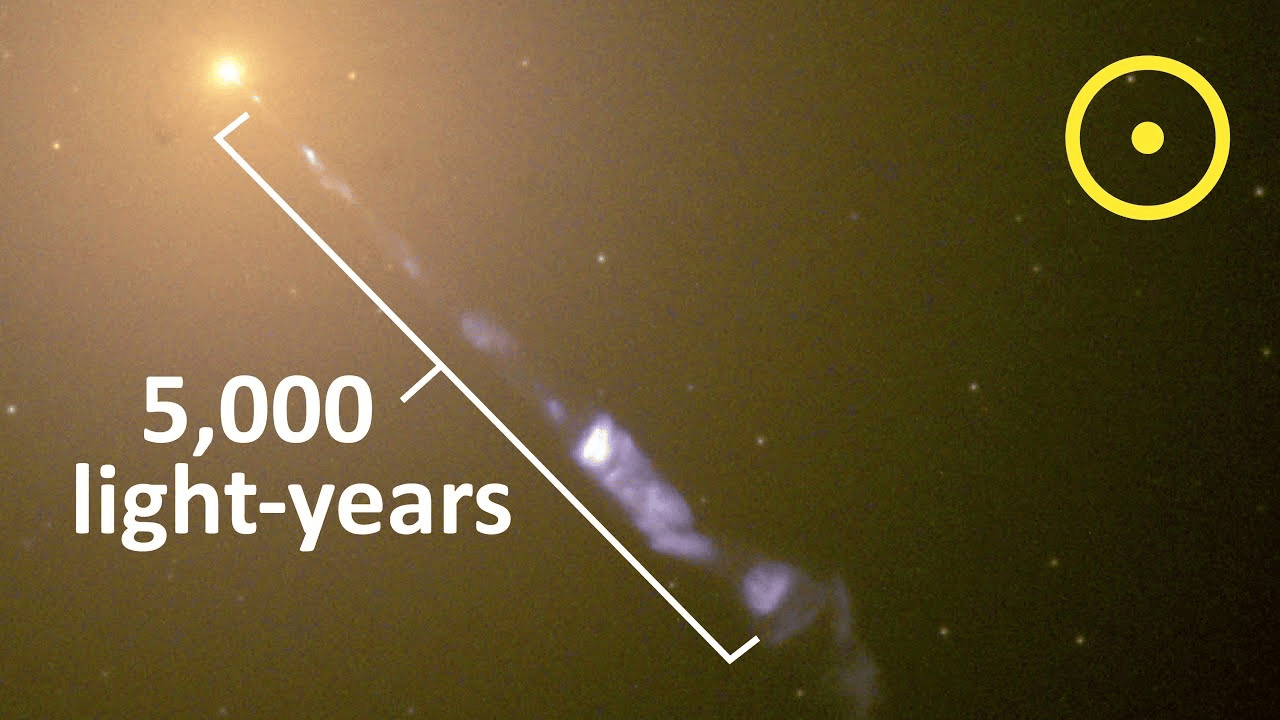
Among the key features is Hubble Space Telescope-1, the first bright spot in the jet, believed to form when the stream collides with a denser region of gas. Astronomers compare its shape to the diamond patterns in a rocket exhaust.
Crucially, the JWST also captured the faint counter-jet on the far side of the black hole. Normally, this beam is almost invisible because it is moving away from Earth at near-light speed; relativity makes it appear much dimmer than it actually is. But as it slammed into another gas region, it flared brightly enough for JWST to detect.


