

Apple has now become the first company to have a fully end-to-end silicon chip supply chain in the United States. This groundbreaking development is part of Apple’s expanded American Manufacturing Program (AMP), now backed by a massive $600 billion investment over the next four years. Of it, 100 billion will be specifically allocated towards the development and sustenance of a U.S.-based chip production ecosystem.
The effort will guarantee that all processes involved in chip production, including the fabrication of advanced silicon wafers all the way to packaging it in its final form, will be done in the United States. This action is part of the strategic shift toward a lack of foreign reliance and the emphasis of Apple to localize its vital supply chains.
The domestic chip supply chain of Apple starts with silicon wafers provided by GlobalWafers America. These wafers are then delivered to the TSMC Arizona plant, which will be the main customer of Apple. Texas Instruments also plans to ramp up production in both Utah and Texas, and Applied Materials in Austin will assemble advanced semiconductor tools needed to create chips.
Such strategic partnerships among the American firms enable the custom chips used by Apple in iPhones, Macs, and other products to be wholly in the United States. Apple will manufacture more than 19 billion chips in 2025 alone.
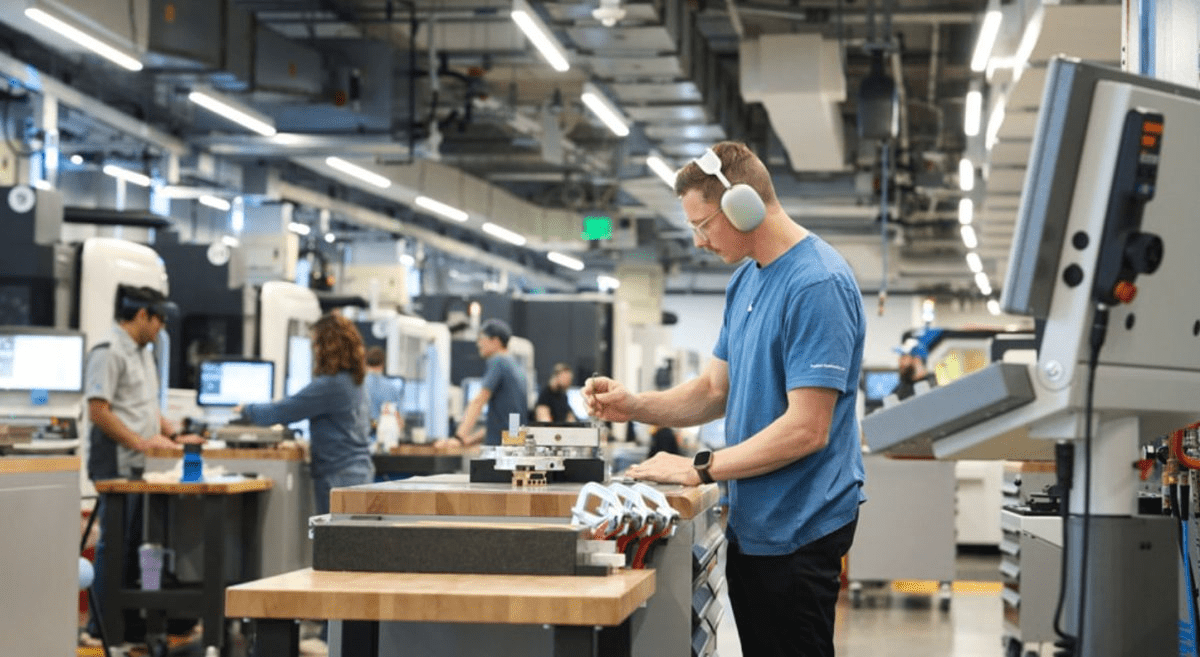
In addition to the chips, the AMP expansion will facilitate the local manufacture of key hardware components. Corning will produce all the iPhone and Apple Watch cover glass in Harrodsburg, Kentucky. Texas and California will manufacture the rare-earth magnets MP Materials produces, which are essential to Taptic Engines. Face ID laser tech will be manufactured in Sherman, Texas, by Coherent.
Apple is not only getting aggressive in its domestic manufacturing due to technology, but it is also economic as well. The company estimates that its supply chain and production activities will underpin more than 450,000 jobs in all 50 states. Even Apple is set to employ more than 20,000 individuals in such areas as R&D, AI, software, and engineering.
This historic investment does not only stimulate the U.S. economy but also makes Apple more resistant to uncertainty in the global supply chain and less dependent on foreign suppliers, as well as aligning it better with national industrial policy.


, now backed by a massive $600 billion investment over the next four years. Of it, 100 billion will be specifically allocated towards the […]&media=https://wonderfulengineering.com/wp-content/uploads/2025/08/GettyImages-1445281649-9065b16ef7984345baf79affbde0e0ee.jpg)