

According to an update published by NASA’s Planetary Defense blog, a 60 meter wide asteroid known as 2024 YR4 has a small but notable chance of colliding with the Moon in December 2032, creating what scientists say would be the most powerful lunar impact ever observed with modern instruments.
The probability of impact currently stands at about 4.3%, and while there is no risk to Earth itself, the possible collision has sparked intense interest among planetary scientists. The reason is simple. An impact of this size has never been directly observed in real time with today’s telescopes, sensors, and space based observatories.
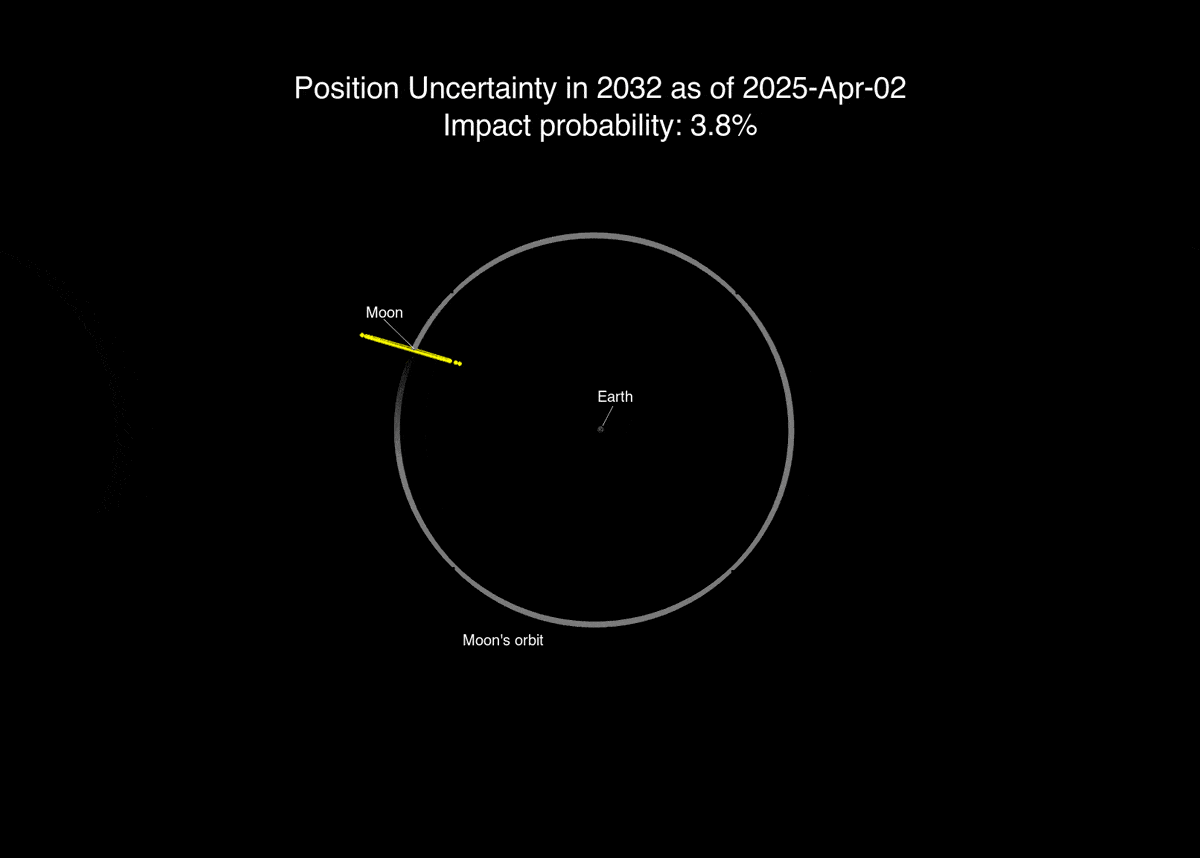
Diagram showing the position uncertainty of asteroid 2024 YR4 in 2032. Credit: NASA/JPL Center for Near-Earth Object Studies.
Asteroid 2024 YR4 is estimated to be traveling at speeds of up to 14 kilometers per second. If it strikes the lunar surface, the energy released would be equivalent to roughly 6.5 million tons of TNT. Scientists estimate it would carve out a crater about one kilometer wide and several hundred meters deep, producing a brilliant flash and a lingering thermal glow that could be detected from Earth.
Impacts shape the surfaces of planets and moons across the solar system, but most are either too small or occurred billions of years ago. This event would allow researchers to watch crater formation unfold as it happens, testing long standing theories about how lunar geology responds to extreme energy.
Researchers believe the collision could also trigger a moonquake unlike anything previously recorded. Calculations suggest the seismic waves could be equivalent to a magnitude 5 earthquake on Earth, far stronger than any tremors detected by the Apollo era seismometers. That seismic data could reveal new details about the Moon’s internal structure, including how debris layers and bedrock transmit energy.
There is, however, one potential downside. A small fraction of the material blasted out of the crater could escape the Moon’s gravity. Scientists estimate that between 0.02% and 0.2% of the ejecta may be launched at speeds high enough to reach Earth’s orbital neighborhood. While tiny in mass, those fragments could pose a real hazard to satellites if they collide at speeds of around 10 kilometers per second.
Such debris could damage or destroy spacecraft and, in a worst case scenario, contribute to cascading collisions in orbit, a chain reaction known as Kessler Syndrome. That risk is one reason space agencies are watching the asteroid’s trajectory closely.
The situation also raises a difficult question. Should humanity intervene? NASA has already demonstrated with its DART mission that altering an asteroid’s path is possible. Deflecting 2024 YR4 would eliminate the satellite risk, but it would also erase a once in a lifetime scientific experiment.
For now, scientists are continuing to refine the asteroid’s orbit and gather data. Whether the Moon becomes the site of an historic impact or the asteroid quietly misses, the event is already reshaping how researchers think about planetary defense, lunar science, and humanity’s growing ability to influence cosmic events.


